
 English
 CN
CNContent
- 1 How the Weave Defines the Fabric
- 2 Tear Resistance vs. Abrasion Resistance: What Actually Matters
- 3 Weight, Breathability, and Comfort
- 4 Fiber Combinations: Cotton, Nylon, Polyester, and Blends
- 5 Where Each Fabric Belongs: Application Guide
- 6 Care, Colorfastness, and Long-Term Performance
- 7 Choosing the Right Fabric for Your Product
Pick up a ripstop shell and a twill work pant side by side, and the difference is immediately visible: one shows a subtle grid, the other a diagonal rib running across the surface. That visual difference is not cosmetic—it reflects two fundamentally different engineering choices, each optimized for a different set of demands. For brands, manufacturers, and sourcing teams deciding which fabric to specify, understanding those choices at the structural level is the only reliable way to match material to application.
How the Weave Defines the Fabric
All woven textiles start with the same raw geometry: warp threads running lengthwise and weft threads crossing horizontally. What changes is how those two sets of threads interact—and that interaction determines nearly everything about how the fabric performs.
In a twill weave, each weft thread passes over one warp thread and then under two or three, with the offset shifting by one thread on every row. The result is the characteristic diagonal rib—called a wale—that runs at a consistent angle across the face of the fabric. This offset pattern means fewer interlacing points per square inch compared to a plain weave, which allows the threads to move slightly against each other, creating a fabric that drapes well and feels soft to the touch. Left-hand twill dominates production in China; right-hand twill is standard in Europe—a detail that matters when specifying yarn twist direction for overseas manufacturing runs.
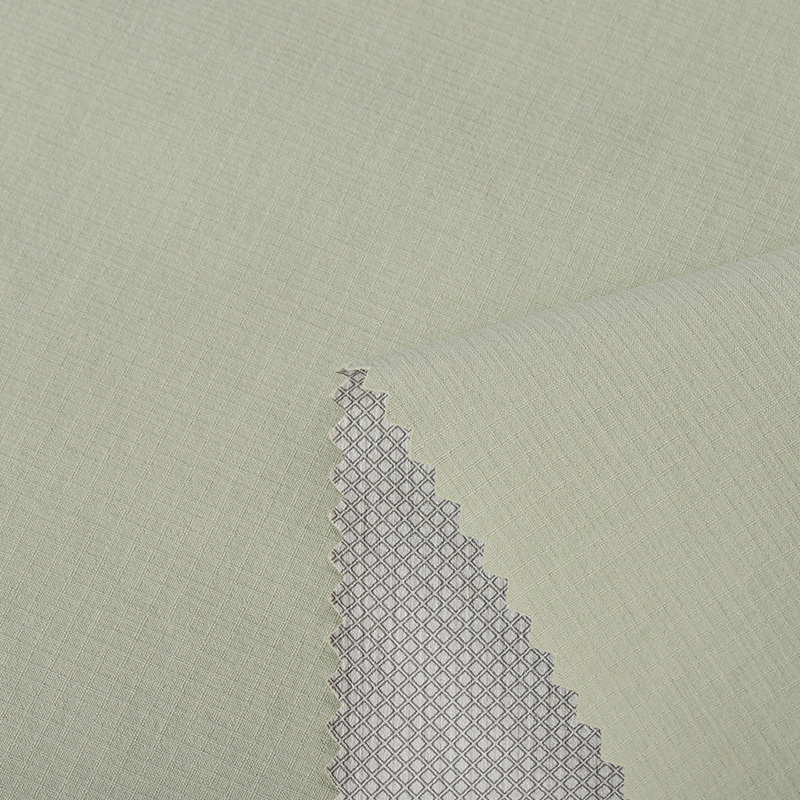
Ripstop takes a different approach. A base weave (often plain or a light twill) is reinforced at regular intervals—typically every 5 to 8 millimetres—with thicker, higher-tenacity yarns woven into the structure. These reinforcement threads form the visible grid pattern. Their function is mechanical: when a tear initiates, the reinforcement yarn acts as a barrier, arresting propagation before a small puncture becomes a catastrophic rip. For a detailed guide to ripstop fabric properties, uses, and care, the structural logic is the starting point for every performance claim made about this material.
Tear Resistance vs. Abrasion Resistance: What Actually Matters
Durability in textiles is not a single property—it is at least two distinct ones, and ripstop and twill are optimised for different ones.
Ripstop's primary performance advantage is tear resistance: the ability to prevent an existing nick or puncture from spreading. The ASTM D2261 tongue-tear test—a standard method that applies a controlled force to propagate a tear from a pre-cut point—illustrates why the reinforcement grid matters. According to Instron's technical documentation on the ASTM D2261 standard, the test measures the force required to rupture individual yarns sequentially at the tear point—precisely the scenario where ripstop's reinforcement yarns intervene. In practice, a fabric snagged on a branch or fence post will stop tearing at the nearest reinforcement thread rather than continuing across the panel.
Twill's durability advantage lies elsewhere: abrasion resistance. Because fewer interlacing points are present per unit area, the threads in a twill weave have more surface exposure and can distribute friction across a larger contact area. The diagonal structure also spreads stress across multiple fibre lines simultaneously, making the fabric resistant to the gradual surface wear that comes from repeated movement against rough surfaces—exactly the kind of wear seen in daily uniform use, warehouse environments, or service-industry roles. Twill can sustain that kind of chronic friction better than most ripstop constructions, even if it is more vulnerable to a single sharp snag.
| Property | Ripstop | Twill |
|---|---|---|
| Tear resistance | High — reinforcement grid arrests propagation | Moderate — no structural barrier to tear spread |
| Abrasion resistance | Moderate — depends on base yarn and denier | High — diagonal structure distributes friction |
| Puncture resistance | Good — grid limits damage radius | Lower — plain-weave zones can be penetrated more easily |
| Structural integrity after damage | Strong — tears stay localised | Variable — damage can propagate if fabric is snagged |
Weight, Breathability, and Comfort
Weight is where ripstop consistently wins. Because the base fabric between reinforcement threads can be woven from fine, lightweight yarns, ripstop achieves a high strength-to-weight ratio that is difficult to replicate with twill at equivalent GSM. A typical nylon or polyester ripstop runs between 70 and 120 GSM for apparel applications; a comparable-duty twill often ranges from 200 to 300 GSM or above. That weight difference is meaningful for understanding denier and fabric weight measurements when designing layered garments where cumulative weight affects wearer fatigue.
Breathability follows a similar pattern. Lighter ripstop constructions—particularly those using nylon or polyester base yarns—allow moisture vapour to move through the structure more freely and dry rapidly after rain or sweat exposure. Synthetic ripstops commonly used in hot-weather military uniforms and outdoor technical gear are specifically valued for this quick-drying behaviour in humid environments.
Twill tells a different comfort story. Softer hand and better drape are consistent properties of twill fabrics across fibre types. The reduced interlacing allows threads to lie more smoothly against each other, producing a surface that feels comfortable against skin during extended wear—an important factor for daily uniforms worn for eight or more hours. Twill also tends to resist wrinkles and maintain a more formal appearance after washing, which matters in roles where professional presentation is required. The denser construction provides more wind resistance and warmth, making it the more appropriate choice in cooler or climate-controlled environments.
Fiber Combinations: Cotton, Nylon, Polyester, and Blends
Neither ripstop nor twill is defined by a single fibre type—both can be constructed from a range of materials, and those fibre choices often matter as much as the weave pattern itself.
For ripstop, the most common commercial variants are:
- 100% nylon ripstop: The lightest and most water-resistant option. Excels in packable outdoor gear, shelters, and high-performance tactical garments. Quick-drying and UV-stable, but can feel slightly stiff and generates static.
- 100% polyester ripstop: Strong UV and colourfastness performance. Commonly used in gear exposed to prolonged sunlight. Slightly heavier than nylon at equivalent thread counts but more cost-effective at scale.
- NYCO (nylon-cotton blend, typically 50/50 or 57/43): The dominant choice in military and tactical uniform applications. Combines nylon's tear resistance and quick-drying properties with cotton's softness and breathability. Accepts flame-resistant (FR) finishing reliably.
- Cotton ripstop: All the breathability of natural cotton with a meaningful improvement in tear resistance over plain-weave cotton. More prone to shrinkage and colour fading than synthetics; requires careful wash specification in bulk production.
For twill, the fibre combinations most commonly specified in workwear and uniform production are:
- 65/35 polyester-cotton twill: The workwear industry standard. Balances abrasion resistance and colour retention from polyester with the comfort and breathability of cotton. Holds shape well across industrial wash cycles.
- 100% cotton twill: Maximum breathability and natural feel. Required in applications where synthetic fibres are restricted—certain FR standards, food-industry environments, or consumer preference markets. More demanding in care requirements at volume.
- 100% polyester twill: Lighter than cotton twill, excellent colourfastness, and low moisture absorption. Common in fast-drying workwear and service uniforms where frequent laundering is expected.
For sourcing teams, the fibre combination choice is as consequential as the weave selection. An NYCO ripstop and a 65/35 polyester-cotton twill serve overlapping markets but carry different production requirements, finishing compatibility, and care label implications.
Where Each Fabric Belongs: Application Guide
The performance profiles above translate into clear, predictable application territories—though there is meaningful overlap in the middle of the spectrum.
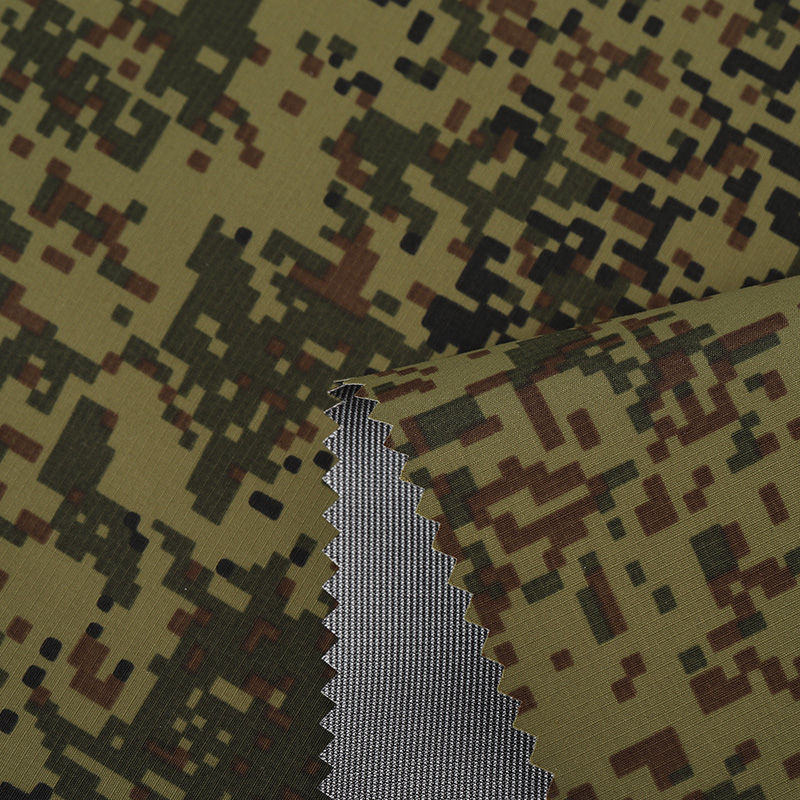
Ripstop is the default choice wherever lightweight durability and tear containment are the primary requirements. Military combat uniforms—especially in hot-weather variants—have relied on ripstop since its development for parachute applications during World War II. Tactical pants, field jackets, tents, backpacks, and kites all depend on ripstop's ability to stay intact after contact with abrasive or sharp surfaces. In the outdoor performance category, performance fabric requirements for hiking, skiing, and fishing apparel consistently favour ripstop for shell layers and high-abrasion panels precisely because weight savings and tear containment are prioritised over pure softness.
Ripstop also appears in waterproof fabric options for clothing and outerwear as a base layer that accepts TPU lamination and DWR coating reliably. The grid structure and tight weave resist delamination over time better than looser constructions.
Twill is the preferred choice when daily comfort, professional appearance, and abrasion resistance across extended wear cycles are the priority. Work trousers, service uniforms, cargo pants, chinos, and tactical dress uniforms are all well-served by twill's combination of durability and soft hand. Security staff, warehouse operatives, hospitality workers, and correctional officers—roles where garments are worn repeatedly and laundered frequently—benefit from twill's resilience to chronic low-intensity wear rather than occasional sharp stress.
The overlap zone is real: tactical pants, for example, are produced in both ripstop and twill, with the ripstop variant preferred for field deployment and the twill variant used for office or administrative duty where appearance standards are stricter.
Care, Colorfastness, and Long-Term Performance
For brands specifying fabric in bulk, care performance is not secondary—it determines how the garment looks and functions after 50 or 100 wash cycles, which is often the threshold that defines whether a product earns a repeat order.
Synthetic ripstops (nylon and polyester) are low-maintenance in production environments. They tolerate machine washing at moderate temperatures, dry quickly, and resist the colour fading and dimensional shrinkage that affect natural-fibre alternatives. Colourfastness in polyester ripstop is particularly strong, making it suitable for garments that require consistent colour matching across seasonal production runs. Cotton and NYCO ripstops require more careful temperature and agitation management to prevent shrinkage; cotton-dominant blends should be pre-washed before cutting if dimensional stability is a priority in finished garments.
Twill's care profile depends heavily on fibre composition. Polyester-cotton twills handle industrial laundering well, maintaining shape and colour over high wash-cycle counts. Pure cotton twills can shrink significantly if washed in hot water and require either pre-shrinking treatments or allowance in pattern making. Cotton twill also tends to wrinkle more after washing than synthetic blends, which matters for uniforms with appearance standards. The flip side: cotton twill hides surface staining more effectively than many synthetic constructions, partly due to the irregular surface texture of the diagonal weave.
One care consideration that applies specifically to ripstop: avoid fabric softeners in the wash cycle. Softener residue can coat the reinforcement grid and reduce the effective moisture-wicking and quick-drying performance that makes synthetic ripstop valuable in active applications.
Choosing the Right Fabric for Your Product
There is no universally superior option between ripstop and twill—the right answer depends entirely on what the garment or product is being asked to do. The framework below consolidates the key decision variables.
| Decision Factor | Choose Ripstop | Choose Twill |
|---|---|---|
| Primary durability need | Tear and puncture resistance | Chronic abrasion and daily wear |
| Weight priority | Lightweight and packable | Heavier construction acceptable |
| Climate | Hot, humid, or high-activity environments | Cooler, indoor, or temperate settings |
| Appearance standard | Field-ready, functional aesthetic | Formal, professional, wrinkle-resistant |
| Fibre preference | Nylon, polyester, NYCO blends | Cotton, polyester-cotton blends |
| End use | Tactical gear, outdoor equipment, shells | Daily uniforms, workwear, service apparel |
| Wash cycle volume | Synthetic variants handle high volume well | Poly-cotton twills built for industrial laundering |
For brands developing product lines that span multiple end uses, a mixed specification is often the practical answer: ripstop for shell and high-activity styles, twill for base layers, trousers, and uniform components where daily comfort and appearance retention take precedence. Understanding what to know before buying sports jacket fabrics wholesale applies equally here—minimum order quantities, lead times, and finishing compatibility all factor into which construction is viable at production scale.
The structural difference between ripstop and twill is the starting point, not the conclusion. Fibre type, GSM, finishing treatments, and end-use environment each layer additional complexity onto the decision. Getting those variables right at the specification stage is what separates a product that performs in the field from one that disappoints after six months of use.