
 English
 CN
Content
- 1 The Short Answer: It Depends on the Chemistry
- 2 Why DWR Earned Its Bad Reputation
- 3 C6, PFAS-Free Finishes, and Where the Market Landed
- 4 DWR Is a Surface Finish, Not the Waterproofing Itself
- 5 Comparing the Common DWR Chemistries
- 6 What You Give Up With PFAS-Free DWR
- 7 Keeping a PFAS-Free Finish Working
- 8 What to Ask a Fabric Supplier
Ask a dozen product developers whether DWR is toxic and you will get a dozen confident answers, most of them only partly right. The truth is that "DWR" describes a function — durable water repellency — not a single chemical. Some of the chemistries used to deliver that function were genuinely problematic. Others are about as ordinary as a textile finish gets. So the more useful question for anyone sourcing outdoor fabric today is narrower: which DWR chemistry sits on the fabric, what does it leave behind, and how does it behave after fifty washes?
We have spent years laminating and coating fabrics for jackets, rainwear, bags and baby textiles, and we have watched this question move from a niche compliance topic to something every buyer asks in the first meeting. Here is a plain-language walk through what is actually known.
The Short Answer: It Depends on the Chemistry
A DWR finish is applied to the face fabric, not the membrane. It lowers the surface energy of the yarn so water beads up and rolls off instead of soaking in. That matters because a wetted-out outer shell feels cold and clammy, and it stops the waterproof-breathable membrane underneath from doing its job properly.
Whether that finish is toxic depends entirely on what it is made of. The DWR families that regulators flagged as persistent, bioaccumulative and toxic were the long-chain fluorinated ones, built on chemistry that also produced PFOA and related PFAS as residuals. The PFAS-free alternatives used widely today — silicone emulsions, wax and paraffin dispersions, polyurethane dispersions — are a completely different story from a health and environmental standpoint.
So if someone asks "is DWR toxic", the accurate reply is: the DWR on a responsibly sourced fabric in 2026 is usually not the chemistry that gave DWR its reputation. But you have to check, because legacy stock and cheap imports still exist.
Why DWR Earned Its Bad Reputation
Through the 2000s, most high-performance outdoor fabric used C8 chemistry — long-chain fluorocarbons. It was remarkable stuff. Water beaded instantly, oil and grease slid off, and the effect survived dozens of wash cycles without much care. It also worked on almost any substrate, which is why it spread so quickly.
The problem was persistence. These compounds do not break down meaningfully in the environment. They accumulate, they travel, and they were found in groundwater, wildlife and human blood far from any factory. Regulators described the family as persistent, bioaccumulative and toxic, and the concern was not only the finished coating but the manufacturing emissions and residuals such as PFOA. PFOS was restricted under the Stockholm Convention in 2009 and PFOA followed in 2019, with a voluntary industry phase-out in major markets completing around 2015.
There is a second, quieter issue too: finishes shed. Every wash releases a little of the coating along with microfibers, which is one reason the environmental argument carried more weight than the direct skin-contact one.
C6, PFAS-Free Finishes, and Where the Market Landed
The first replacement was C6, a short-chain fluorocarbon. It kept much of the performance and reduced bioaccumulation, and for a few years it was presented as the fix. Most brands now treat it as a stopgap at best, because it is still a PFAS and still persistent. Increasingly tight restrictions on PFAS in textiles in Europe and parts of the United States have pushed the industry toward elimination rather than substitution.
What replaced it is a family rather than a single product:
- Silicone-based DWR — good beading, soft hand, widely used on shells and softshells.
- Wax and paraffin emulsions — natural feel, moderate performance, shortest lifespan.
- Polyurethane dispersions — durable on synthetics, often combined with silicone.
- Hyperbranched polymer systems — newer entrants aiming to close the performance gap.
None of them contain PFAS. All of them come with trade-offs you should plan for rather than discover after production.
DWR Is a Surface Finish, Not the Waterproofing Itself
This distinction causes more confusion than almost anything else in fabric sourcing. A three-layer shell typically has a face fabric with a DWR, a membrane in the middle, and a tricot or mesh backer. The membrane is what blocks liquid water. The DWR is what keeps the face fabric from saturating so the membrane can keep breathing.
That means you can specify a PFAS-free DWR and still keep the same waterproof rating, because the rating comes from the membrane and the seams, not the repellent finish. We stock and laminate TPU, PU, PTFE and TPEE membranes in-house, which lets us test finish and membrane combinations together instead of guessing.
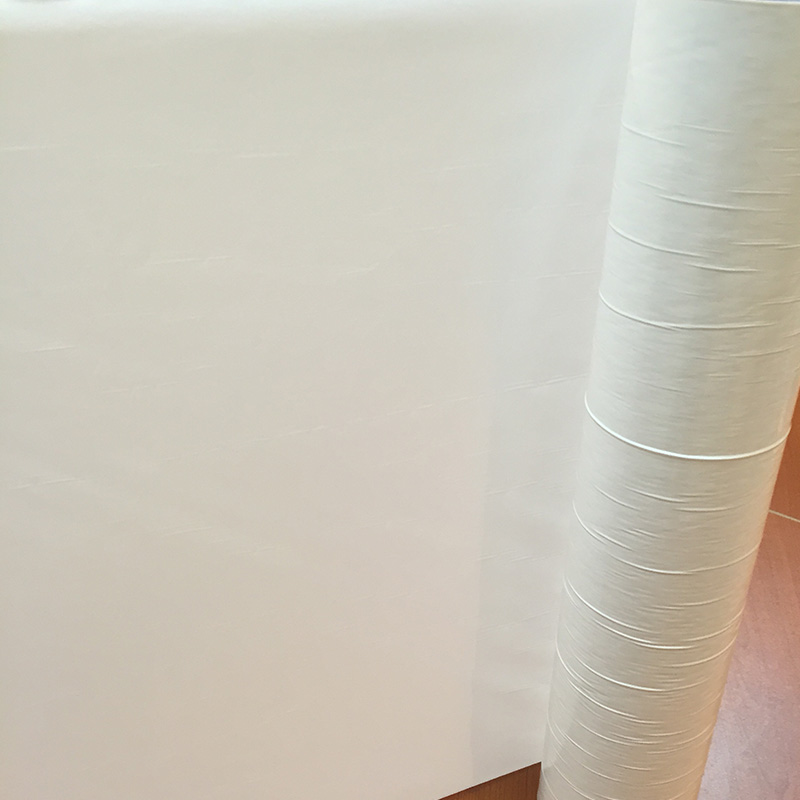 TPU/PU/PTFE/TPEE Blackout Functional MembranesView waterproof, breathable, windproof blackout membrane options in TPU, PU, PTFE and TPEE, with varied breathability, thickness and colors for laminate development.View Product →
The practical takeaway: separate the two decisions. Choose the membrane for hydrostatic head and breathability. Choose the DWR for chemistry, hand feel and durability.
Comparing the Common DWR Chemistries
| Finish family | Water and oil repellency | Health and environmental profile |
|---|---|---|
| C8 long-chain fluorocarbon | Excellent beading and strong oil resistance; very durable | Persistent PFAS with PFOA residuals; phased out in major markets |
| C6 short-chain fluorocarbon | Good beading, moderate oil resistance | Still a PFAS and still persistent; lower bioaccumulation; stopgap only |
| Silicone based | Good beading and soft hand; weaker oil resistance | PFAS-free; low concern; refresh needed sooner |
| Wax or paraffin | Moderate beading; natural hand | PFAS-free; low concern; least durable of the group |
| Polyurethane dispersion | Moderate beading; good durability on synthetics | PFAS-free; profile depends on the formulation |
What You Give Up With PFAS-Free DWR
Honesty helps here. Without fluorinated chemistry there is no oleophobic barrier, so oils, sunscreen, insect repellent and food will absorb into the face fabric and leave dark marks. Beading performance is usually a little lower from new, and it fades faster with abrasion and washing. Some silicone finishes change the hand, making fabric feel slicker or softer than the sample you approved.
In practice this means three adjustments: a slightly higher add-on level, a care label that tells the consumer how to reactivate the finish, and a realistic expectation that the garment will need a refresh coat within a couple of seasons of hard use. For most brands that is an easy trade once the alternative is a restricted substance.
Keeping a PFAS-Free Finish Working
Most "failed" DWR complaints are actually dirty fabric. Body oils, sweat salts and detergent residue sit on the yarn and mask the finish, so water stops beading even though the chemistry is intact. A warm wash with a technical detergent, a thorough rinse and a low tumble dry or gentle iron usually restores performance, because heat re-orients the hydrophobic molecules on the surface.
If you want realistic expectations for your care labels, our note on C0 DWR and PFAS-free water repellency covers wash cycles, reactivation and how to word consumer guidance without overpromising.
What to Ask a Fabric Supplier
Bring four questions to your next mill meeting and you will separate serious suppliers from catalogue sellers quickly:
- Which DWR chemistry is on this article, and can you provide a PFAS declaration?
- What is the beading performance after 5, 20 and 50 home launderings?
- How does the finish affect hand, colour fastness and seam sealing?
- Is the finish applied in-house or at a third-party finisher, and is that finisher audited?
For shell fabrics, ask for the full construction too — face, membrane, backer and finish — because the DWR interacts with all of it. Our three-layer outdoor functional waterproof fabric is built with exactly that conversation in mind, and we are happy to send matched face-and-finish options so you can compare beading and hand side by side.
 Three-Layer Softshell Outdoor Waterproof TPU FabricCompare three-layer face, membrane and lining combinations, including TPU films and varied breathability, hand feel and waterproof ratings for outdoor shell development.View Product →
Different end uses also pull the specification in different directions. A hiking shell prioritises durable beading, a children's jacket prioritises skin safety and softness, and rainwear prioritises cost per metre. If you are weighing those trade-offs, it helps to look at how these fabrics are used across outdoor gear before locking a finish.
So, is DWR toxic? The finishes that earned that label are largely gone from responsible supply chains, and the PFAS-free replacements are a genuine improvement rather than a marketing reset. What remains is a diligence task: confirm the chemistry, test the durability, and write care instructions that keep the finish alive. Do that, and the water repellent on your garment is one of the least worrying things in it.